
Remember a couple of months ago when I wrote about traveling solo? Well, I made it happen!
It was solo travel lite, in the sense that I got on a plane solo and flew to Texas for a long weekend to visit friends who are, like, the awesomest hosts ever. They picked me up from the airport, they put me up at their house, they cooked me food and took me out to eat and to hike and to visit the library and to see a play, and I had a great time and then came home with a vacation hangover as I remembered that, in my daily life, I’m mainly the one who does things for other people rather than the other way around. It’s cool, though. I recovered within a couple of weeks and now I’m doing (slightly) less for my family and planning more solo trips. I just need to dodge my kids’ busy spring and summer schedules.
One of the other things I did with my Texas friends was to attend a Unitarian Universalist service. I started out as a UU in a large congregation in the South, and this was the first time since I moved away from North Carolina in late 2003 that I’d attended a service at a large congregation in the South. Texas and North Carolina are quite different states, but the energy, especially at this time in history, was very familiar. The sermon left me with quite a lot to think about in the intervening weeks about how I’d like to navigate the political climate and all of the chaos happening at the federal level right now.
The biggest takeaway for me was how important it is for those of us who disagree with how things are going to unite to protect our democracy. We’re experiencing the dismantling of a lot of things that we’ve taken for granted for decades, and this has unlocked fears that weren’t in the awareness of many of us and, at least for me, this has led to feeling extremely cautious about the people around me. I see in myself and others a tendency to circle the wagons. Even more alarming to me, I find myself wanting to categorize people—often based on relatively small things, like the kind of car they drive or what color tie they wear or if they wear ballcaps with sunglasses and windbreakers—to protect myself and my family from uncomfortable situations. But I realize that this is just what those sowing this chaos want us to do: other and distrust one another so that we can’t unite against them.
There are lots of people with whom we share common values even if we don’t share the same faith or the same identity or the same formative experiences, and I want to figure out how to build connections with them. To this end, I’m doing work to identify the core issues that I feel need to be defended. For me (for now), it’s twofold: the inherent worth and dignity of every person and protecting the structure of the government as outlined in the Constitution, as that’s the basis for all of the stability we’ve enjoyed for so long. I’m attempting to keep these in mind and view all interactions through the lens of these core issues with a goal of creating connection (assuming the person I’m interacting with isn’t actively trying to harm anyone…that requires a different response, but so far, thankfully, I have not had this experience).
For example, I had an interaction this past week with a medical doctor that was very surprising and anxiety-provoking to me. While talking about what seemed an unrelated topic, this person started quoting right-wing talking points, and my initial inclination was either to argue or to shut down. Instead, I managed to note my emotions and take a breath before responding. I asked myself, where are the points of agreement between us? Where can we find common ground? My goal wasn’t to argue a position, but just to present the idea that while we can agree that the stated goals are positive, the method for getting there is too destructive. There’s room for change, but we won’t have anything to build from if we destroy the foundation. This opened up an interesting line of conversation as it revealed that this person had essentially no idea of how the government is structured (for example, they didn’t realize that the NIH and the TSA were part of the federal government), and this allowed us to have a conversation that wasn’t stuck in talking points.
I don’t imagine that I’ve changed this person’s viewpoint, but by talking with them calmly, meeting them where they were, and building on our existing relationship, I’m hopeful that I’ve opened up another way of seeing things for this person. And if I haven’t, at least I feel good about how I interacted with them.
I’m trying to do this when interacting with those who agree with me, too, gently pointing out when I observe language that others and dismisses, and I have to admit, this is just as scary for me as interacting with those who disagree. Being yelled at or insulted tends to ruin my day, and when we’re reacting out of fear as so many of us are right now, we tend to defend ourselves by yelling or insulting, or, in my case, getting sarcastic or retreating into self-righteous silence, none of which fosters connection. But I’m working not to let that fear keep me from trying to connect.
And it is definitely work.
So, in between all of this attempted connection, I am giving myself a break by un-self-consciously spending time in fictional worlds. Here’s what I read in February:
February Completed Books:
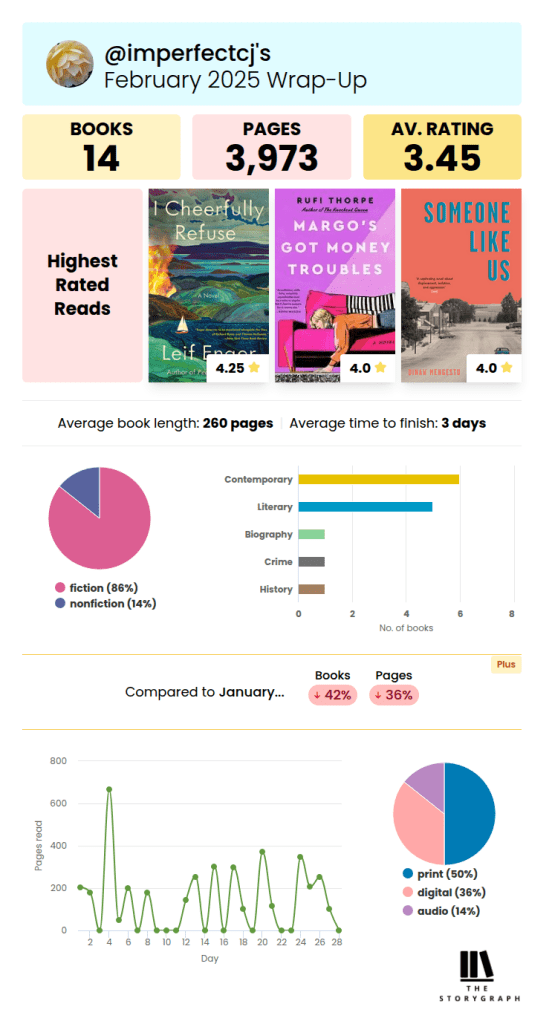

My favorites from this bunch:
- I Cheerfully Refuse by Leif Enger
- Margo’s Got Money Troubles by Rufi Thorpe
- Someone Like Us by Dinaw Mengestu
Currently Reading:
- The Fountain Overflows by Rebecca West (still)
- The Ministry of Time by Kailiane Bradley
- The Room by Jonas Karlsson
To-Read for March:
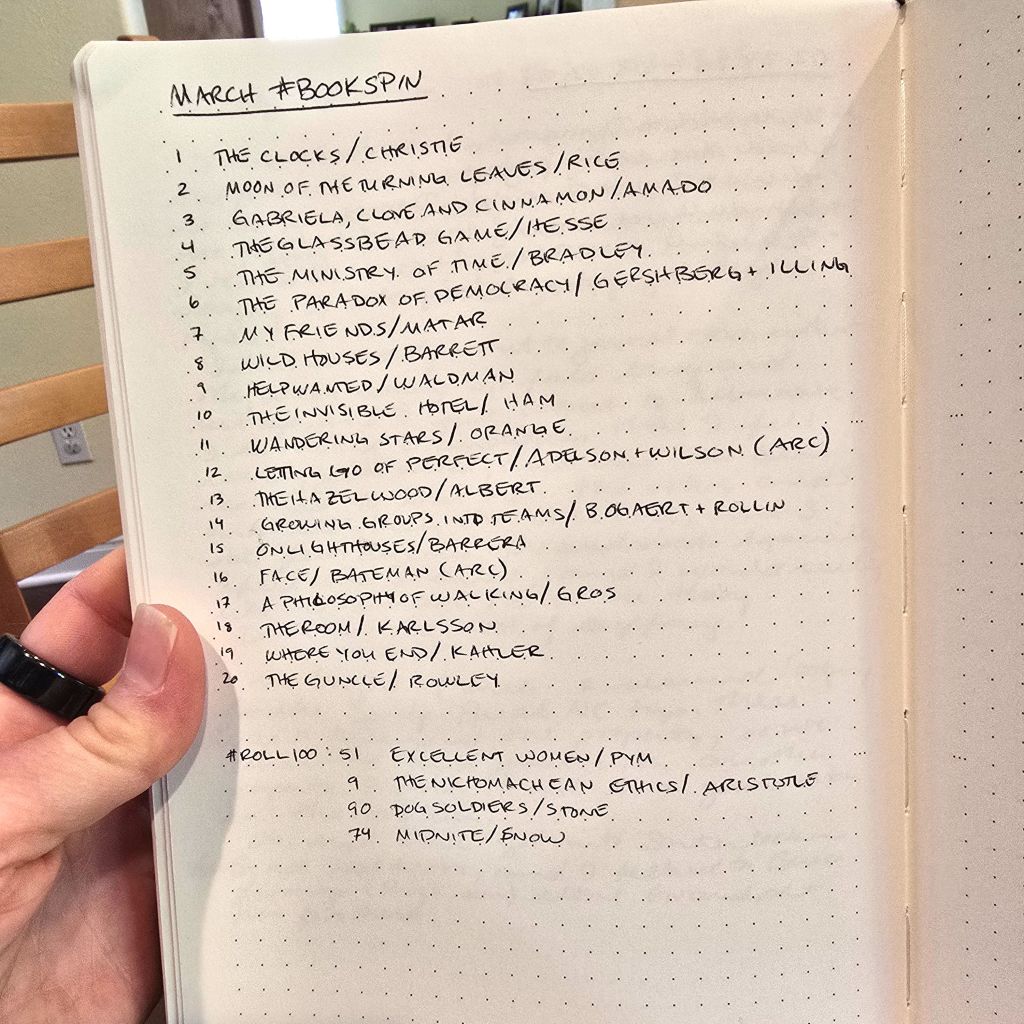
In addition to my StoryGraph, you can see my Litsy profile for status updates throughout the month.

 Imperfect Happiness