
This January I joined a challenge to read one book each month on a different United States president. We’re going in order so 2026 is George Washington to Zachary Taylor. The state of the Union and the unremitting cliffhangers in the daily news (“Will democracy survive in the United States? Tune in tomorrow!”) have had me on edge for about the past year or so, but I’m finding it reassuring to spend the first few months of 2026 with the Revolutionary Generation.
This isn’t because George Washington, John Adams, Thomas Jefferson, James Madison (and influential but non-presidential folks like Alexander Hamilton, Patrick Henry, Benjamin Franklin, and Abigail Adams) were model figures who always made great choices. Rather, what I find comforting is the fact that these were all very flawed individuals, ambitious and often with fragile egos that led to some poor decisions and not a little hypocrisy. These big personalities disagreed on a lot of things and often disagreed loudly, but they came together to first break from Great Britain and then to form a nation of a type never seen before. They didn’t do this by setting aside their disagreements; they did it by arguing for hours and days and weeks and months. They showed up and disagreed constructively and felt bored in endless meetings and expressed their opinions and frustrations in letters and articles and bit by bit built something new, and, I think, kind of wonderful (in a flawed and often hypocritical way). They didn’t know they would succeed, and many, many times they were on the brink of everything coming apart before it could even get started. But it did come together and they did succeed.
Part of what facilitated their success was the unique collection of personalities that brought together flaws that were canceled out by strengths. For example, Thomas Jefferson’s idealism pushed the boundaries of John Adams’s pragmatic nature and Adams’s pragmatism made it possible to turn Jefferson’s lofty language into a Constitution, all while George Washington provided the image of a king for a population weaning itself off of monarchy while shaping the principles of the new nation by refusing to become a king himself. Had there been just one of these personalities and not the others, it’s hard to imagine that the United States would ever have formed at all.
Of course, this constructive conflict devolved after just a few short years into duplicity (the secretive Thomas Jefferson) and faction-forming (um, Jefferson again) and posturing for power (Alexander Hamilton, the would-be North American Napoleon), and we’ve needed some really big resets along the way, but the country was founded on the ability of a group of people to disagree well enough to piece together a new type of government that has persisted against all odds for 250 years.
The fact that the country wasn’t created in a smooth chronology by perfect people but rather was cobbled together by intelligent and principled but deeply flawed human beings gives me hope that maybe what we’re experiencing now is just another reset and that eventually the intelligent, principled individuals alive today will come together with a commitment to disagreeing honestly as a means of promoting and protecting the principles of democracy. I hope for a group of elected officials to set aside any natural desire for power or personal enrichment to bring character and integrity back to the national stage and serve the entire population, not just those with the deepest pockets.
I can’t control whether this happens or not, but I do have control over my actions. I can do my best to act according to my principles and to be accountable to the image of myself that I want to embody. I can engage respectfully with people with whose viewpoints I disagree and demand accountability for those who do wrong or hurtful things, not out of vengeance or anger but out of a commitment to principle, character, and treating people right just because they’re people.
And I can keep reading, not just presidential biographies (which, interesting as they are, would be tough to palate if they were my entire reading diet), but any book that provides me with a vantage point outside of my limited perspective.
Here are the perspectives that I explored in February:
February Completed Books:
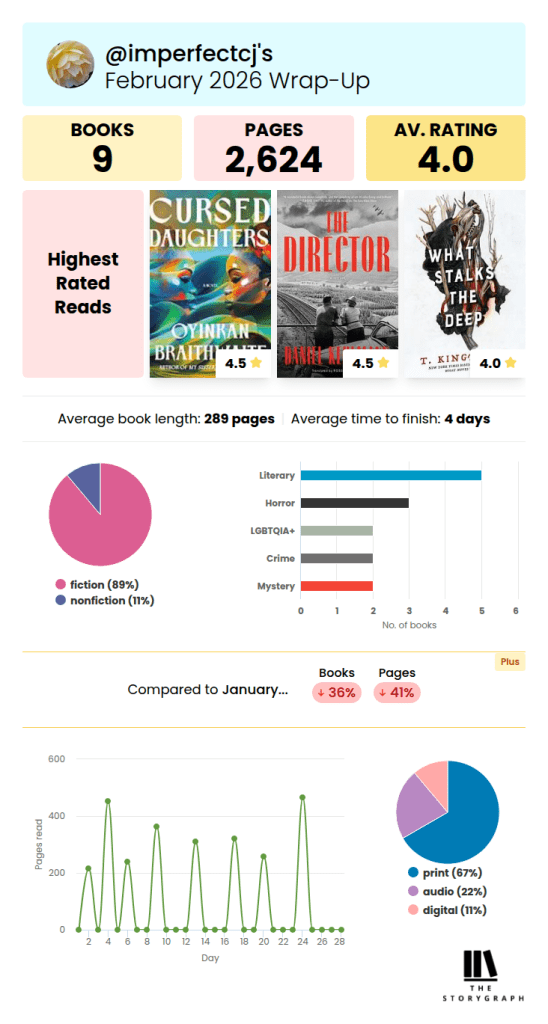
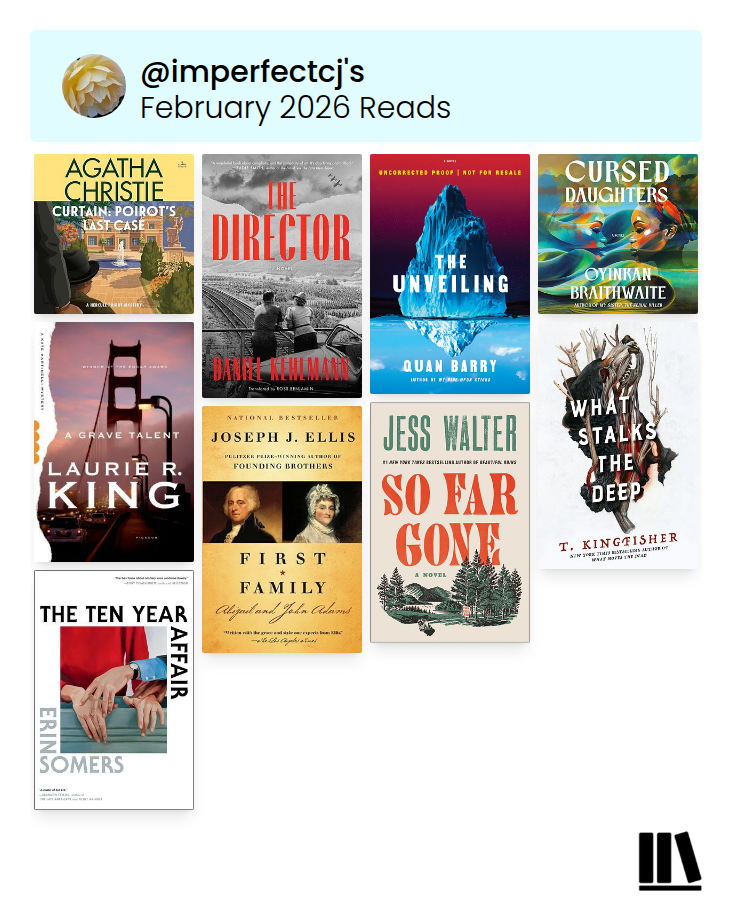
My favorites from February:
- The Director by Daniel Kehlmann
- Cursed Daughters by Oyinkan Braithwaite
- First Family by Joseph J. Ellis (my John Adams book)
Currently Reading:
- Changing Places by David Lodge
- Swann’s Way by Marcel Proust
- American Sphinx by Joseph J. Ellis (my Thomas Jefferson book)

 Imperfect Happiness
What is the presidents book challenge? I’m interested in joining. Enjoy your blog and I’m impressed with your monthly reading amount! I’ve followed you since your homeschool era (mine too, is now over). Lindsey S
LikeLike
Hi, Lindsey S-
How awesome that you’ve been reading my blog for so long! I’m sometimes surprised I’m still writing posts. 🙂
The US Presidents reading challenge I’m doing was started by two users on Litsy (if you’re on Litsy, let me know your handle or connect with me there, and I can tag you on one of the posts). I also keep track of my progress with a list posted by a user on The Storygraph (you can find it by searching “US President Biographies” in the challenges section of The Storygraph), but it’s not associated with the Litsy challenge; I just use that list so I don’t have to create my own challenge. It’s basically just reading a biography or other book related to a US president each month, going in order starting in January 2026. So George Washington in January, John Adams in February, and now Thomas Jefferson in March. Some presidents have a LOT more written about them than others.
I hope this helps, and thanks for reading!
-Charity
LikeLike