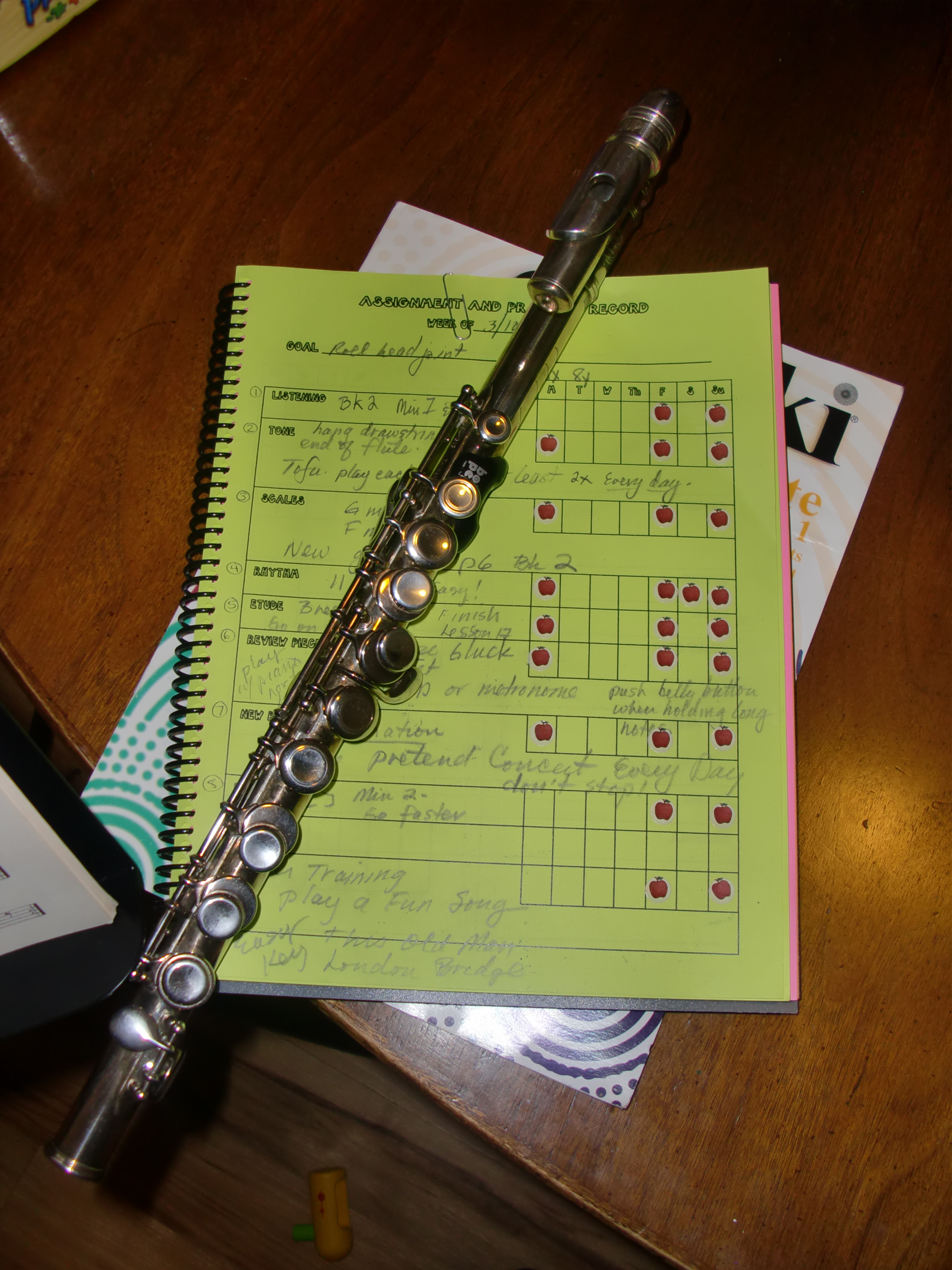
My friend K came over today with her boys to play and hear my daughter play her flute. K is a flute teacher, but not my daughter’s flute teacher. She’s currently on hiatus from teaching and is missing working with students, especially the cute little ones like my daughter, which was part of the purpose of her visit.
It was interesting how quick and painless the practice session with K was. My daughter was so excited to show off all that she knows that she just bounced from one thing to the next with no sass-back at all. Not that I expected sass-back with a person she doesn’t know that well, it was just a pleasant change from our usual mom-and-daughter practice routine, which generally involves one or both of us yelling and/or crying.
I used to take the practice-time power struggles as evidence that I shouldn’t homeschool or at the very least that I shouldn’t help my daughter with flute practice. But I see it differently now.
I see that the power struggles are inevitable, and if they didn’t happen around flute and math, they’d happen around food or cleaning up toys or screen time.
Since we can’t avoid the power struggles, I’ve fairly successfully embraced them as opportunities to improve our relationship (at least during the times that we’re not practicing flute). It’s an opportunity to use all of my skills—breathing before I explode, speaking in a loving tone of voice, defusing the situation with goofiness, offering hugs and labeled praise, being present with my child. Sometimes this is a real fricking hassle. Most times I don’t get through it exactly as I wish I could (which is perfect, loving, and June-Cleaverish for the entire hour we practice).
Part of why I lose it is because my expectations are not realistic. I want to be perfect, sure, but I also realize (with some shame) that I want my daughter to be perfect, too. It’s not that I expect perfect performance, just perfect behavior. I want her to accept my corrections without argument, I want her to try everything seriously, and I want her to work through her practice until she has a sticker in every box for the day. When I lose sight of my “loving mother” goals, it’s when I let myself become more invested than she is in whether she’s got a sticker on every practice item. I start worrying about what her teacher will think of me when she sees those empty spaces where stickers ought to be.
And here’s the hard part: this is not about me.
My daughter’s success or failure must be hers alone. My job is to assist her, direct her, and encourage her. And my job is to step back and let her sink or swim and to be there to love her regardless of the outcome. If I take her success or failure on as my own, what does that leave her?
How do you react to power struggles with your kiddos? Do you find yourself trying to take ownership of their performance? How do you manage this reaction?

 Imperfect Happiness
I am working with how I handle power struggles daily, as well. We don’t have a music practice yet. But it’s coming soon when piano begins at 5yo. I’m also working on this from scratch because my role modeling for this was shifting expectations, no boundaries, annoyance and disinterest. I fight against those armed with “expert” knowledge from all the gentle discipline books that I’m attempting to memorize.
LikeLike
Your parental role models sound similar to mine. I definitely feel like my parenting is about faking it, or put another way, going through the motions until I’ve internalized the gentle discipline stuff.
LikeLike
I could have written a lot of this post, and it’s an issue that my violinist daughter and I struggle with frequently. It’s also becoming more prominent now as she gets older (she’s 9 1/2) and needs to be taking more responsibility for her practicing and progress.
I totally agree with you though- I worry that when I take her to a lesson unprepared that it’s going to reflect poorly on me. Doubly hard is that her teacher is a friend and a colleague.
Although I have to say, although I’m sorry that you’re struggling with practicing, I am glad to read of other’s struggles because it helps me to realize I’m not the only one beating my head against the wall during practice sessions.
LikeLike
When my daughter’s teacher basically described to us, before I’d told her details, what was going on during our practices, I felt much better. It’s like when your toddler goes through a hitting stage. It doesn’t take away all of the anxiety around the behavior, but knowing that it’s part of a stage that others also go through (and live through) helps keep things in perspective. At least it does for me.
I can’t say that I’m all that excited to hear that it’s likely to get worse for us as she gets older, though…
LikeLike